norman's website
  • Home
  • Blogs
    • Scraps of life blog
    • Creative Academic >
      • BYOD4L BLOG
    • Garden Notes
  • Books
  • Change
  • Creativity
  • Professional services
  • Contact me
  • EC-Conference
  • Delft
  • luminate
  • OU employability
  • Qinghai
  • CISC
  • NTU
  • creativejam
  • CRC
  • GMIT
  • BNU STUDY VISIT
  • AIT
  • portsmouth
  • DIT
  • TLC
  • BERA
  • ICOLACE4
  • PDP
  • OUC
  • MMUni
  • Derby
  • dmucreatives
  • Chester
  • Brighton
  • Buckinghamshire
  • Hallam
  • St Marys
  • LIMERICK
  • kingston
  • UWL
  • SEDA
  • MACAO
  • Beijing
  • IFIUT
  • CRA seminar
  • FBSEworkshop
  • birmingham
  • Creativity in Higher Education
  • graduatestandardsprogramme
  • MAKING MEANING

Landscapes & Soundscapes

15/1/2018

0 Comments

 
Picture
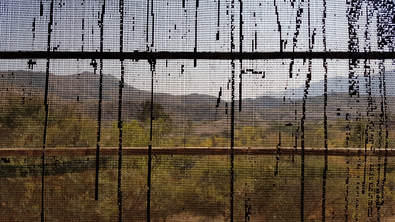
I had come to Swaraj to see how they approached project-based learning. As a self-directed learner, just like the khoji’s, I decided to undertake my own mini project. I was inspired by the landscape I could see from my window (right). One of the groups was involved in a listening project and I was intrigued by the idea oflistening as a form of engaging with the environment. So I decided to wander in the landscape and listen to the sounds in it.
 
I took a 3 hour walk along the road I could see from my window. I walked at a slow pace so I could take in the landscape and listen to the sounds. Periodically I stopped walking and sat on a rock, closed my eyes and just listened and felt the atmosphere. I used an audio recorder to capture some of the sounds I heard. As I wandered I realised that the soundscape was as much a part of the landscape as the rocks and trees. The sounds were the manifestations of animals that were living in the landscape – insects, birds, bullocks, goats, people.  It brought back memories of the time I had spent in Saudi Arabia as a geologist when I was often alone in a landscape not dissimilar to the one I was now in. Indeed, part of my experience on that walk was to interpret the rocks in the landscape as well as the way the people were using the landscape. A landscape means so much more when we can comprehend what we are seeing. The people I met were friendly given the oddness of a pale skinned foreigner walking in their landscape: it was as if it happened every day. This simple experience gave me a lot of pleasure and I decided to do the same when I got home in my own landscape. When I got back home I mixed the sound and the photos I had taken to produce a simple movie that conveys something of my experience.
 
My ecology for learning.
 
This was me interacting with my physical environment and learning from my interactions. I had a need and desire (will/motivation) to create a simple learning project to provide khoji’s with an illustration of how the concept of a learning ecology can be applied to real world learning situations. My context, embedded in the Swaraj educational process, my research into the Swaraj project-based learning process, and my longer term research into learning ecologies, (note I am a context) all provided me with purpose and fuelled my motivation.
 
I was attracted to the scene I could see from my bedroom window. It reminded me of similar landscapes I had worked in as a geologist in western Saudi Arabia which has similar climate and topography. My past experiences were influencing my thinking in the present.
 
To fulfil the project brief – interacting with the outer world and forming new perspectives as a result of my interactions. I imagined a journey through the landscape paying particular attention to three things – the geology (the rocks and structures that shaped the landscape), the way people had shaped and inhabited the landscape and the sounds in the landscape (the soundscape).

​My journey in the landscape unfolded over 3 hours. I then spent another 2 hours later in the day writing these notes and another hour in the early hours of the following day as fresh ideas came to me as I lay in bed. I then spent another 2 hours doing an evening walk and I will spend another 3 or 4 hours in the future producing a simple movie blending the sights and sounds I had witnesses to accompany these notes. [Nb the absence of connectivity hindered my ability to produce the movie I wanted to make as I write these notes].
My landscape was on my doorstep so it was easy to access. The affordances for learning where in the landscape and the process I created to experience, document and reflect on what I had experienced. The resources were all around me – the physical landscape, the rocks and the living things in it, I used a number of tools and technologies - my notebook to record thoughts and feelings, my camera to record what I saw and my audio recorder to record the sounds I was hearing. I will eventually use my imovie software to mix the sound and visuals together. I also needed water to sustain me – the landscape reminded me that without water I would not flourish. The output from this exercise will be a new resource – my notes and the accompanying movie I will make available so that others can use.
 
My ecology embraced the wonderful physical spaces of the landscape and the intellectual and psychological spaces I created to experience being in the landscape and to pursue my inquiry. As I journeyed I formed a relationship with the landscape and the sounds in it – walking along the road, climbing the hills and sitting or standing quietly. I met some people and said hello (namestai), people reacted in a friendly and respectful way. I even asked through signs if I could take their photos and several people gave me permission, but some did not.
 
I made good use of my camera and recorder and their use was never far from my mind. Should I record what I am seeing or hearing? In my mind I was also relating to the idea of learning ecologies especially as I write these notes.
 
My process began with my walk and the pauses I made along the way to sit quietly and think about what was happening. It was peppered with photographic and audio recording and occasional note taking. After my walk I reflected on my experience, and I’m doing this again as I write up my notes. Reflection is also likely to happen when I talk about my experience and when I create my movie.
What did I learn about myself in the outer world through this interaction?
 
My journey of learning did not happen in a simple linear way. I have indicated that it has occurred in several episodes within the landscape, while writing, while in bed and in future when I make my movie. Through my writing and movie making I try to bring my learning into a coherent whole and present it in a way that makes sense to me and hopefully to others.
 
The story of the landscape
 
Drawing on knowledge I developed many years ago as a geologist – I can see that the landscape is formed from metamorphic rocks, softer greenish phyllites and harder white or buff coloured siliceous rocks. There are also abundant lenses and veins of quartz. From the intercalated nature of the rocks I am assuming that they were originally laid down as a sequence of muds and fine sands in an ancient sea before being compressed and folded – the rocks are steeply dipping to the north. The rocks have been eroded by water into a series of hills and valleys - dry water courses can be seen in the bottom of valleys that are presumably full during the monsoon season. One of the watercourses has been dammed – over 10m high and a small lake has been formed containing water all year round. Water is a very precious resource here.
 
Human impact on the landscape
 
People have shaped this landscape they have dammed the river, built a metalled road, dug ditches, built dry stone walls to retain soil and in the valleys create temporary ponds so the water can sink into the ground. Where there is enough soil they have cultivated the land. They build their houses and walls from the flat stones beneath their feet and there are several quarries.
 
In one idyllic spot where the road crossed a small valley I found a well in the valley floor, perhaps 10m deep showing me that there was groundwater at this depth. It had a pump that fed a trough for the cows. It also fed numerous pipes for irrigation and domestic purposes. A number of crops were being grown in this valley.  The thought occurred to me that the agricultural practice developed at Swaraj called ‘gangamandal’ could be shared with the farmers in this valley.
​Soundscapes - sounds in the landscape  
 
Paying attention to the soundscape was an entirely new learning experience for me. While I am aware of the sounds around me and how they enrich my experience, I rarely pay attention to them for more than a few minutes. Perhaps because I am learning to record my band at the moment the idea of recording sounds appealed to me.
 
Daytime walk
 
I made two observations on my walk – firstly sounds sit in particular parts of the landscape but they are transient, secondly some sounds move into and through my particular soundscape eg a person riding a motorbike comes into and then moves out of the soundscape.  I concluded that no sounds were permanent in a space but some sounds could be heard frequently in the same space.
 
During my journey I walked into a number of soundscapes as people were doing particular activities. The first activity was chopping trees. The sound of chopping carried long distances. This activity was happening all over the valley and was clearly a major enterprise. It was undertaken by older women who used axes or sickals (curved cutting tools) to copice trees, while the younger women collected the cuttings, bound them into bundles and carried them on their heads.
 
The second activity was cooking or washing. As I came near to dwellings I could hear pots and pans being used. It was close to lunch time so I guessed it was the preparation of food. Dwelling places near the road had a repertoire of sounds, children, women talking to children, goats bleating, dogs barking and sounds of domestic activity.
 
The third activity was herding goats, mostly the goats were in one place but on occasion I saw them being herded by two girls.
 
The fourth activity was children playing, usually around their house but also I saw and heard a small group playing on top of a hill.
 
One of the commonest sounds on the road is made by people driving motorbikes which seems to be the main form of transportation. These are usually ridden by young men often two and sometimes three to one motorbike. You can hear the engine for many minutes before it comes into view and the same as it disappears from view. I waved to the riders as they went passed me and invariably they smiled, waved back or said hello.
 
As well as sounds made by humans there are also sounds made by the animals who inhabit the landscape - birds, insects, goats and bullocks, all add their voices to the soundscape. Even the trees have a voice as the wind rustles their leaves. All these things bring the silent landscape to life.
Some of the sounds I recorded. Unfortunately I had no wind shields so the wind dominates some of the soundtracks - lesson for the future

Walking in the windy landscape
Sounds in the landscape
Goats, wind, insects, cow, people
Woman calling her goats
Woman chopping tress and collecting wood
Two men on a motorbike
​ Evening walk
 
I did a second walk the day after in the late afternoon and evening between 4.30 and 6.30. As the sun went down. I found myself a hill about 1km from Swaraj and sat down to wait for darkness. For most of this time it was quite still and quiet. There were fewer people in the landscape and the few that were seen were on their way home. Sounds were more muted and concentrated around the dwellings scattered on the hillside. There were fewer birds singing, insects buzzing or goats bleating. The sun went down behind the highest hills and by 5.45 it was very gloomy. At this point the cicadas began to sing especially in the wadis where there was more vegetation. By the time I reached Topovan there was a cacophony of insects and possibly frog sounds. The soundscape had fundamentally changed.
Dusk soundscape
 Night soundscape 
Impact on me
 
The #walkingcurriculum (Gillian Judson) gets learners out of the classroom to experience the world. My walk taught me the power of a walk, punctuated by pauses, to experience, sense and make sense of the unfamiliar world on my doorstep. They changed my perception of me interacting with my environment, which was the purpose of the brief that khoji’s had been given. By taking time to experience and record some of my sensory experiences, I was able to create a deeper perspective on this particular experience of the world.
 
Firstly, I felt present in the landscape and when I sat, looked and listened, I felt part of the landscape. I also realised I was also part of the soundscape. As I walked on the dusty road my feet crunched the stones, my bag made a noise as it rubbed against my side and when I climbed a hill by breathing became louder and I heard stones roll away as I dislodged them with my feet. These noises interfered with what I could hear forcing me to stop frequently so I could hear the sounds that nature was making.
 
Secondly, I recognised my walk provided me with a rich sensual experience. I was conscious of my senses feeding in information from the environment through seeing, hearing, feeling eg the sunshine and wind on my skin and the stones crunching under my feet, smelling (eg walking past the carcass of a dead cow or a pile of dung) and tasting as I drank my water sparingly or licked the salty sweat off the top of my lip. All my senses were engaged – that is the power of a walk in which we pay attention to what our senses are telling us.
 
Thirdly, I felt joy. I enjoyed the physical effort of the walk and climbing hills and the way the road led me over hills to new vistas and experiences. I saw things I hadn’t seen before, like two eagles swooping over my head. I enjoyed the positive reactions of people as I said hello, and the laughing girls carrying wood who posed for me to take a photo. Because of these responses I felt that I was being accepted into the owners of this landscape, if only for a few moments.
 
Because of the context and the time and opportunity Swaraj has given me, I felt I had been able to taken my senses for a walk and pay attention to things they were telling me in a way that I do not normally do. In this respect it was an extra-ordinary experience. I enjoy walking at home but I thought I would try this approach of taking a camera and recorder and spending time thinking about what I was experiencing as I wandered. The experience gave me an insight into how I might facilitate an experiential workshop using these ideas.
0 Comments

Swaraj learning community & learning ecosystem

12/1/2018

1 Comment

 
Picture
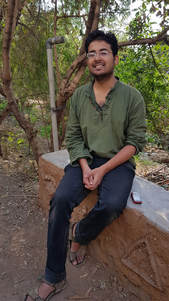
​Swaraj University is located in the hills 12km south of Udaipur.  My journey along narrow twisting roads through sparsely vegetated hillsides helped prepare me for the rural setting of the campus at Topovan Ashram. A rusty gate with a welcome home sign signalled I had reached my goal and I was met by a small group khoji’s (student learners) and Rahul Hasijah (right) who was the chief facilitator and my host.
 
The idea of university conjures images of a large campus for thousands of students and academics providing higher education that is recognised through degrees. But Swaraj is not like this: it's more like a commune in the sense of a small closely knit community of people who share common beliefs about education and practices in learning. The idea of a learning ecosystem seems more relevant and useful to me (discussed in another post).
​ 
The hills surrounding Swaraj are quite barren perhaps 70% is rocky outcrop with little soil: it felt very much like the terrain I had worked in as a geologist in Saudi Arabia. It’s not easy to sustain life in this inhospitable environment but somehow the local people with their herds of goats and small areas of cultivation, managed to. Looking back from the hills the campus looks like an oasis thanks to Mr Mitra (a former Dean of Education at an Agricultural College) who came to live here 28 years ago cultivated and irrigated the land growing vegetables, bananas, dates and papaya and more.

I was quickly welcomed into this community of 'seekers' (khojis [learners] and facilitators) and during the week I had many conversations that demonstrated their commitment to the ideals and philosophy of holistic learning and concerns for a sustainable world in tune with the needs of urban and rural Indian communities. Each day we met as a community for breakfast, lunch and dinner (an sometimes afternoon tea!) when discussions covered all sorts of topics. The group also periodically met to share progress and to review and reflect on where they were and how they were feeling about their projects. There seemed to be little distinction between khoji’s and the facilitators.
A project-based approach to developing self-directed learners 
 
My own project, the reason I had come, was to learn about the context and how Swaraj encouraged learners to develop themselves as autonomous self-directing learners. My particular interest was how the pedagogical practices being used enabled khoji's to create their own ecologies for learning and achieving.  Obviously I was limited to the observations I could make during the week I had chosen for my visit. During this time 7 khoji’s in the first year of the programme were part way through their second 6 week Khoji - meet. The activity they were undertaking was a self-managed project whose purpose was to interact in some way with the world outside the campus and develop a (new) perspective for themselves of the world they were interacting with. They had to decide on the output from the process and present their interaction to peers. I was not able to see these projects from start to completion but I saw enough to appreciate the learning through doing process.
 
Khojis and facilitators had organised themselves into five project groups.
Picture
​Gp1: One khoji had chosen to try to interact with people who lived in the hills behind the campus. She was being helped by an experienced facilitator and together they were trying to gain a better understanding of how the people who inhabited the inhospitable landscape managed to survive asking questions like, What does everyday living look like through their eyes? How do they sustain themselves and their families? The student and facilitator had encountered people in the fields and on the roads and had entered into conversations but it had become increasingly difficult to engage people who were suspicious of anyone they didn’t know. She and the facilitator were documenting their experience in notes and photographs. The outcomes from this project to understand people and how they lived in the landscape were to be shared with the group and preserved for future generations of khoji’s in a photographic documentary.

​Gp2: A second group of two khoji’s had decided to interact with people in the town through a stall they would set up selling artefacts that they had made, including earings made from shells and beads, wristbands and cotton bags.
Picture
​Gp3: Another khoji was undertaking a project on listening. She had decided to engage shopkeepers as her subject and she wanted to engage them in conversations about their anxieties and fears. She had prepared herself using role play. The facilitator was engaged in his own project, he was going to stand around with a placard inviting people to talk to him about anything they wanted to talk about. Both people were interested in how they coped with their own fears of interacting with people they did not know in these highly personal ways.

​Gp4: A fourth group chose the idea of engaging with the outer world through music. Using a range of percussion instruments. Using a range of instruments (hand drums, guitar, finger symbols and a one stringed instrument called an ectara (which means one string) and voices they experimented with spontaneous rhythms and chants and replicating existing songs. They believed that people who are not trained musically can come together and make music. They intended to perform in public after a couple of days composing and rehearsing and see what responses they received from their audiences. During rehearsals it became clear that there was a tension between the desire for creative self-expression (this sounds nice and feels good to me) and the need to consider the audience and what sorts of sounds/music they would be receptive to. One khoji in the group had given considerable thought to the project and made extensive notes. She raised many possible ideas and the negotiation that followed was to acknowledge the wealth of ideas but encourage a focus on one idea in order to achieve the goal. During the day I spent with the group there was much experimentation but no decision on what they were going to play when they interacted with people off campus.
​Gp5: The final group of two khoji’s wanted to interact with children. They were both interested in ‘facilitation’, One of them had recently facilitated a workshop for about 50 people at the Learning Society conference and the other shoji had several years of experience as a facilitator working with an organisation called ‘play for peace.’ They chose to work with the ‘rak pickers’, children who lived in one of the poorest areas of Udaipur who picked over the rubbish and recycled stuff that had been thrown away like plastic bottles. ​​The two khoji’s were being helped by a former khoji/part time facilitator who had set up an informal space within the rak picker community to engage children and adolescents in interest-driven informal learning activities. 
Picture
​I spent an afternoon with this group and witnessed one of the khoji's facilitating a 1 hour session using play with a group of around 26 children from about 3 to 12, boys and girls. His facilitation was masterful and the kids responded with enthusiasm and joy to his games. The other khoji tried to work out how she would engage the kids on her next visit. She found out they liked painting and was considering a session where she used painting as a medium to engage them to explore the idea of community.

Ecological perspectives on this way of learning
 
The reason for my visit was to try to understand how Swaraj facilitated the development of autonomous, self-directing learners in the context of their mission to develop social entrepreneurs. Clearly, I was only able to see a snapshot of a substantial programme and the fact I had picked the week of my visit meant I could only observe what was happening in that week. However, my working hypothesis is that the best way to develop learners as consciously competent creators of their own ecologies for learning and achieving is primarily through projects that they conceive, design and implement themselves. Fortunately, the type of learning processes I was able to witness was the type of process I was hoping to see.
 
From my field observations I was able to see that a simple brief – interact with the world outside the compound and pay attention to what you are learning through the experience, provided the catalyst for imagining, self-organising, discussion and decision making, planning and preparation and then execution of a strategy in cultural/social situations that were unfamiliar, uncertain and unpredictable. Some of the contexts being worked in were quite challenging and required a degree of courage. Perhaps also there was a level of naivety in expectations of what could be achieved, but perhaps this was also necessary as it provided a good basis for learning from the experience. The involvement of experienced facilitators or former khojis with particular knowledge and skills was instrumental in enabling khoji’s to make progress. In the short time I was there, projects were executed to varying degrees of success and some had yet to be fully implemented. Within the process facilitators encouraged participants to understand themselves and be aware of what was happening ie they were instrumental in developing conscious competence.

From khoji’s descriptions of what they had been doing I knew I could relate their thinking, doings, relationships and interactions to my framework for learning ecologies but I wanted to encourage khoji’s to recognise that learning and practice were intimately bound up in an ecology that they created/co-created.
​The opportunity came when I was given the chance to facilitate a 90min workshop on the fourth day of my visit. I decided I would introduce the idea of learning ecologies, provide my own example (see story below) and invite participants to use the framework to reflect on their projects.
 
Notwithstanding the difficulty of working across cultures and languages the exercise seemed to work and the four groups that were involved were all able to tell a story using the ecological framework to provide a structure to the story (stories were recorded on video). The general consensus was that there was value in the ecological framework as an aid to reflecting on and analysing a complex learning experience

Philosophical underpinnings of the learning ecosystem


Learning ecosystems do not just inhabit a physical space or environment - they also inhabit an intellectual or philosophical space.

Swaraj has none of the features we typically associate with a university. It lacks the monolithic bureaucracy, centralized admin systems, hierarchical management, disciplinary academic structures, research, IT and other resource infrastructures. Nor does it have the QA systems and regulatory procedures. But it is an organization that is committed to helping people to learn and develop themselves. Instead it has belief and value systems and culture and educational practices that are based on a philosophy of self-governance – Swaraj. Its scale is that of a family with a culture of shared beliefs rather than a diverse complex society with competing goals, which is a university. As a family everyone knows and cares for each other. In my view Swaraj is best appreciated as a learning ecosystem devoted to promoting and supporting particular forms of self-regulated learning.

In a conversation I recorded, Rahul identified what he considered to be the key features of the community’s ecology for learning as:
  • The focus on head, heart and hands. We help learners appreciate that learning through doing and experiencing what they do involves the practical, the cognitive and the emotional dimensions its not just an intellectual process.
  • Learning is not just a personal matter it’s a collective matter – your decisions and acts impact on others. As they interact with the world, their families, working in communities they become more aware of their connection to a bigger self. There is a lot of peer to peer learning. We expect khojis to motivate and help each other.
  • We emphasise the idea of living a healthy life with a concern for our environment and how it can be sustained. Over time khojis begin to question the value of money and what constitutes a resource. Connected to this we promote the idea of a gift ecology viewing learning as a gift and by helping others to learn and live we are giving the person a gift. Our concept for mentors is part of our gift culture. They don’t get paid - they give their time, knowledge and skills  to help others learn.
  • Our concept of teaching is that of facilitation in which facilitators are as much a part of the collective or social learning process ie working alongside khojis on their own learning projects, as they are helping khojis to learn and develop. The role of facilitation is not about holding the hands of khojis but of supporting and challenging when it is necessary.
Picture
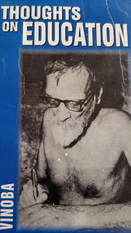
To understand how these ideas and practices have come about it is important to understand the context of Swaraj, and its links to the philosophies on which it is founded. Firstly, the Swaraj approach to learning has been influenced by its parent organization Shikshantar which has been quite radical in its experiments to break away from the traditional models of education & schooling.  Shikshantar has been influenced by the educational philosopher Vinoba and Rahul’s parting gift to me was a book by Marjorie Sykes ‘Thought’s on Education’, which is a translation of Vinoba’s essays published in Shikshan Vichar (1956). Vinoba, a contemporary and friend of Ghandi, was a scholar, thinker, writer and advocate for social reform. His thinking on education is linked to social reform in the wake of India’s independence. It amounted to a rejection of the British-based education system. 

​Shikshantar http://shikshantar.org/ a Jeevan Andolan (life movement), was founded to challenge the culture of schooling and institutions of thought-control. Today factory schooling and literacy programs are suppressing many diverse forms of human learning, intelligence and expression, as well as much needed organic processes towards just and harmonious social regeneration. Schooling is the crisis. In the spirit of Vimukt Shiksha, we are committed to creating spaces and processes where individual and comunities can together engage in dialogue to:
  1. generate meaningful critiques to expose and dismantle/transform existing models of Education, Development and Progress;
  2. reclaim control over their own learning processes and learning ecologies;
  3. imagine (and continually re-imagine) their own complex shared visions and practices of Swaraj
At the heart of Vinoba’s search for Nai Talim (‘new education’) is the idea of self-reliance, self-sufficiency and self-governance which are also at the heart of the Swaraj approach to education and learning.
  
It seems to me that education must be of such quality that it will train students in intellectual self-reliance and make them independent thinkers. If this were to become the chief aim of learning, the whole process of learning would be transformed.. a student would be taught that he is capable of going forward and acquiring knowledge himself.. it is a mistake to think that life knowledge can be had in any school. Life knowledge can only be had from life. The task of school is to awaken in its pupils the power to learn from life. (Sykes p30-31).
Vinayak Narahari "Vinoba" Bhave (1895 – 1982) was a scholar, thinker, and writer who produced numerous books. He was a translator who made Sanskrit texts accessible to the common man. He was also an orator and linguist who had an excellent command of several languages (Marathi, Gujarati, Hindi, Urdu, English, Sanskrit). Vinoba Bhave was an innovative social reformer and an advocate of nonviolence and human rights. He was arrested several times during the 1920s and 1930s and served a five-year jail sentence in the 1940s for leading non-violent resistance to British rule. The jails for Vinoba became the places of reading and writing. He wrote Ishavasyavritti and Sthitaprajna Darshan in jail, learnt four South Indian languages and gave a series of talks on Bhagavad Gita in Marathi, to his fellow prisoners.  https://en.wikipedia.org/wiki/Vinoba_Bhave
The purpose of learning is freedom and freedom is another word for self-reliance. Self-reliance means freedom from dependence on others, or any external support. 

Self-sufficiency, then has three meanings. The first is that one should not depend on others for one’s daily bread. The second is that one should have developed the power to acquire knowledge for oneself. The third is that a man should be able to rule himself, to control his senses and his thoughts. p31
 
In line with these ways of thinking Vinobe identifies a number of features of Nai Talim (‘new education’) 
 
1 Teachers and students must regard themselves as fellow workers. ‘The major need is for the teacher and student to become work partners and this ca happen only when the distinction between the teacher and ‘teaching’ and the student and ‘learning’ can be overcome’ p62
2 Knowledge and work are both forms of the same thing and it is impossible to distinguish between a knowledge process and a work process. p62
3 NT does not discipline students it gives them complete freedom p63
4 NT is a philosophy of living its an attitude to life that we have to bring to all our work p69
5 Everyone ought to do manual labour for his food p73

All these ideas can be seen in the Swaraj learning ecosystem.

Are these educational ideas and practices relevant to UK higher education? I would say, with the exception of the 5th idea, they are. The core idea of a project-based, peer with peer collaborative learning underpinned by teacher and mentor facilitators is highly relevant to the enterprise of enabling learners to prepare themselves for a complex world. 
1 Comment

Udaipur

6/1/2018

0 Comments

 
I arrived in Upaidur in the early hours and it was still dark. My first impression in the dark and half-light as I drove from the airport in a considerately driven taxi, was that it felt like parts of Saudi Arabia. The style of buildings some of them quite make-shift and looking derelict, and the lots of rebuilding, and the roads and how they were being used, the hills, the industry.

I am staying at the Jagat Niwas Palace hotel on the edge of Lake Picholla, without doubt it is the most beautiful part of Udaipur. But I was so tiered after 22 hours without sleep, that after I checked in I slept for nearly 5 hours. I woke to a warm, sunny early afternoon and venturing outside my room, which opens onto a terrace, I was able to appreciate the beautiful surroundings I am in. My hotel, was originally a mansion built in the early 1600’s and its a wonderfully proportioned building formed around an open courtyard on 4 levels including a roof terrace. All the rooms open onto the courtyard and terraces and dotted around the walls are cosy nooks where you can sit and drink tea. The palace overlooks Lake Picholla around which are many other palaces, parks, hotels and other buildings. Across the lake in the distance are the hills of Rajasthan beyond which the country becomes arid and desert like. Udaipur is the historic capital of the kingdom of Mewar in the former Rajputana Agency. It was founded in 1553 by Maharana Udai Singh of the Sisodia clan of Rajput and remained as the capital city till 1818 when it became a British princely state. The city is a chaotic maze of little twisting streets full of tut-tuts, motorbikes and cars jostling with pedestrians and freely wandering cows. Down by the water’s edge people wash themselves or their clothes. This is India as I imagined it with the ancient and modern co-existing side by side. I know I’m in a place with a long history and rich cultural past and a busy present.  It was frustrating not to have a guide to interpret what I was seeing: on a boat trip round the lake I could see that there were many buildings of significance but I don’t know what they were. Fortunately, I was able to use google maps to at least identify the points if interest I was looking at.  As I wandered the streets I found the people to be friendly and as a foreign visitor I felt safe and welcome and I was treated with respect whenever I had a conversation. This was my introduction to the context in which my fieldwork is located.
​On my second day as a visitor to Udaipur I’d planned to visit a number of places of interest and my first on my list was Jagdish Hindu temple built over 400 years ago. I had not seen such a structure and detailed carvings before – what craftsmanship. As I entered the temple I was greeted by someone who very soon became my self-appointed guide. But I was soon grateful as he explained the history and meaning of what I was experiencing. He told me he was an artist- rather he led a group of artists: and his house next to the temple. Towards the end of the guided tour he led me down a passage into a room containing many miniature paintings of traditional scenes. It was immediately apparent that this was a sales pitch. I liked the artwork but I had no intention to buy at the seriously inflated prices – several hundred pounds for one featuring a court scene that I liked. I had seen similar paintings or prints in shops for a fraction of the price. I listened respectfully but after about 20mins I had to break off what had been an amicable conversation.  On reflection I can see that my self-appointed guide had worked hard to develop a personal relationship in the hope that I would trust him or perhaps feel obliged to purchase his artwork. 
 
Picture
I found this experience interesting in the light of the book I had just finished reading –‘Start Something that Matters’ by Blake Mycoskie founder of TOMS – ‘Tomorrow’s Shoes’.  Blake had been inspired, during a visit to Argentina, to create a business with a social heart through two different experiences. The first involved buying and wearing the traditional shoes called the ‘alpargata’ – his first idea was that the show might have market potential in the USA. The second experience was witnessing first hand children walking the streets with no shoes. He connected his business idea with the idea that at the core of his business model he would place the idea of gifting. For every pair of shoes that were sold his business would donate a pair of shoes to a child without shoes. The idea of ‘1 for 1’ was born as a way a business could make a positive and direct impact on the world.
 
I bought this book at the airport and thought it would be a good idea to read it as part of my prep for my visit to Swaraj. I love the core idea in the book that the world would be a better place if business that sought to make a profit, ‘give’ as well as ‘take’ from the world. I thought about my own small enterprises and viewed them from the gifting perspective. They are underpinned by the idea that we,  (me and the volunteers I work with) are working on behalf of educators all over the world and the fruits of our research (our writings / magazines) are gifted to the community of interest we support through Creative Commons licences.  The 1for1 model doesn’t work for us because we don’t actually sell anything, we give our own time to develop the perspectives that we then share freely. Blake’s story challenges me to ask, ‘is that enough?’. Can we go further to provide gifts for people who have far fewer educational opportunities than I have had. Perhaps my visit to Swaraj will help me explore this question.


0 Comments

Field Trip to Udaipur

6/1/2018

0 Comments

 
I love doing fieldwork – discovering for myself the detail, beauty and complexity of natural phenomenon. It’s this combination that attracted me to geology. Field work in education

​. I’m writing this post sitting in Mumbai airport at 3am, my first foot in India, so to speak, and the start of a new ed(ucational)venture.
 
The story of how I came to be here began six months ago, while undertaking research for the creative pedagogies for creative learning ecologies project I came across a TEDx talk by Rahul Hasijah. He talked about the education provided by Swaraj University near Udaipur in Rajastahn province of NW India to develop learners as social entrepreneurs. Like many TED speakers his talk was quite inspiring and I searched for more information. I found the university website and an article he had written and emailed him to see if we could republish it in Creative Academic magazine. He readily agreed and in my capacity as editor I helped him develop the piece. Through our conversation I formed a plan to visit the university and Rahul was very encouraging.
 
Journeying – field trips are all about participating in a journey that involves mentally and physically getting ready and the participating in a journey that takes us from what is known into the unknown. Of course life itself is a never ending journey and where we go is as much about our orientation to exploration as it is to our circumstances.  

Six months after discovering Swaraj University here I am on my way to Udaipur feeling excited, expectant and a little apprehensive as well as feeling a bit odd after travelling for 13 hours with another 6 ahead of me before I reach my hotel in Udaipur.
 
Travelling puts you into a liminal state – betwixt and between, moving from one place to another from what is familiar everyday to what, in this case is completely unfamiliar.  I remember from my days as a geologist that sometimes fieldwork involves a continuous process of travelling. Making a new path in order to discover new things. Here I am journeying towards a specific place inhabited by particular people who do particular things for particular purposes. My fieldwork involves journeying into their lives for a short while to try to connect their lives to my own.
 
I have done some preparation and I think I know what sort of things I want to learn, but of course what emerges may be totally different. I want to understand how this form of entrepreneurial education has come about – it is itself the product of entrepreneurs seeing and acting on opportunity driven by strong personal beliefs, and what it is about the context that enables it to flourish. I want to know why the teachers – facilitators and mentors have got involved in this novel educational project. I want to appreciate how learners experience these forms of education, why they have chosen to participate in it and how they fell they are being changed by the experience. I want to see what I can learn from this approach to education that I can incorporate into my own practice, and my hope is that I can form new relationships from which new, as yet unimagined, possibilities can grow.
 
I have lots of questions but sometimes you just have to experience something in order to know what questions to ask and this is why I have come here in order to experience the context in order to understand the questions I need to ask – and that is at the heart of the idea of fieldwork – to experience and better understand the context.
0 Comments

    Purpose

    To develop my understandings of how I learn and develop through all parts of my life by recording and reflecting on my own life as it happens.
    @lifewider1
    @lifewider
    @academiccreator

    I have a rough plan but most of what I do emerges from the circumstances of my life 
    Picture
    Picture
    Picture
    View my profile on LinkedIn

    Archive

    January 2021
    December 2020
    September 2020
    August 2020
    May 2020
    March 2020
    February 2020
    January 2020
    November 2019
    October 2019
    August 2019
    March 2019
    January 2019
    April 2018
    March 2018
    February 2018
    January 2018
    November 2017
    September 2017
    August 2017
    July 2017
    June 2017
    May 2017
    April 2017
    March 2017
    February 2017
    January 2017
    November 2016
    October 2016
    September 2016
    July 2016
    June 2016
    May 2016
    April 2016
    March 2016
    January 2016
    December 2015
    November 2015
    October 2015
    September 2015
    August 2015
    June 2015
    May 2015
    March 2015
    January 2015
    December 2014
    November 2014
    October 2014
    September 2014
    August 2014
    July 2014
    June 2014
    May 2014
    April 2014
    March 2014
    February 2014
    January 2014
    December 2013
    November 2013
    October 2013
    September 2013
    August 2013
    July 2013
    June 2013
    May 2013
    April 2013
    March 2013
    February 2013
    January 2013
    December 2012
    November 2012
    October 2012
    September 2012
    August 2012
    July 2012
    June 2012
    May 2012
    April 2012
    March 2012
    February 2012

    Categories
    these are the tags I've used 

    All
    5C's Of Social Media
    Achieving
    Applying Learning
    Appreciation
    Attention To Detail
    Awareness
    Band
    Beautiful Day
    Being Influenced
    Being Influenced
    Beliefs
    Bonding
    Book
    Bucket List
    Caring
    Climate For Change
    Cocreation
    Co Creativity
    Co-creativity
    Collaboration
    Collective
    Commitment
    Communication
    Compassion
    Conceptualising
    Conference
    Conflict
    Connected
    Connected Learning
    Connections
    Constructionism
    Creativity
    Creativity In Development
    Creativity Nurturing
    Crowdsourcing
    Cultural Exchange
    Culture
    Curriculum
    Dealing With Emotion
    Dealing With Emotions
    Dealing With Setbacks
    Dealing With Situations
    Designing
    Development
    Disruption
    Disruption In Life
    Ecology
    Emergence
    Emergent Need
    Emergent Opportunity
    Emotion
    Emotion (negative)
    Emotion (positive)
    Empathy
    Engagement
    Enthusing Others
    Environment
    Experience
    Experimenting
    Facilitation
    Failure
    Families
    Family
    Feedback
    Fulfilling Our Purposes
    Goals
    Good Ideas
    Great Idea
    Growing Up
    Guilt
    Health And Fitness
    Histrory
    Ideas
    Identity
    Illness
    Inflections In Life
    Influences
    Influencing
    Information Flow
    Insights
    Inspiration
    Interest
    Intergenerational Learning
    Joy
    Juggling
    Knoweldge And Understanding
    Knowledge
    Knowledge And Understanding
    Knowledge Development
    Knowledge Working
    Leadership
    Learning
    Learning Ecologies
    Learning Ecologies
    Learning Ecology
    Learning For Teaching
    Learning Through Experience
    Learning To Cope
    Learningtoday
    Liberation
    Lifedeep
    Lifewide
    Lifewide Learning
    Lifwide Education
    Liminal Space
    Looking Back
    Love
    Making A Difference
    Making Progress
    Making Progress
    Making Something
    Managing Self
    Men's Sheds
    Models
    Motivating Others
    Motivating Self
    Motivation
    Motivational Strategies
    Motivation By The Spirit
    Motivations
    My Fitness
    My Purposes
    Narrative
    Narrative Inquiry
    Narrative Inquiry
    Natural Beauty
    Nature
    Neurological Process
    Opportunities
    Partnership
    Paying Attention
    Performance
    Personal Creativity
    Personal Development
    Personal Development Planning
    Perspective Change
    Planning
    Play
    Procrastination
    Purposes
    Reflection
    Relationships
    Remembering
    Retirement
    Role Model
    Sadness
    Sarendipity
    Seeing Potential
    Seeing Potential
    SEEK SENSE SHARE
    Self Motivation
    Self-Motivation
    Self Regulation
    Self-regulation
    Significant Personal Events
    Slogging
    Social Age
    Social Leadership
    Social Media
    Sorrow
    Spiritual
    Stories
    Survey Monkey
    Symbolism
    Teaching
    Teamwork
    Technology
    Tools
    Tradition
    Trajectories
    Twitter
    Using Technology
    Values
    Vision
    Visualisation
    Wellbeing
    Why?
    Willpower
    Work
    Working Out What You Have To Do
    Workshop
    Writing

    RSS Feed