I have been working on the next issue of Lifewide Magazine which aims to explore the idea of disruption in life and how individuals cope with and overcome significant disruption, and change, adapt and grow through their experiences. I cannot help but be moved by the personal stories of suffering, loss, fortitude and resilience. Overcoming such adversity in life is testament to the strength and vitality of the human spirit.
The human condition is to try to understand situations in order to make good decisions about how to act or not act. Some situations are easy to comprehend: they are familiar and we have dealt with them or something like them before and we are confident that we know what to do. Others are more difficult to understand and some are impossible to understand until we have engaged in them. The amount of stability will vary from one person's life to another. Instability leading to disruption is not something that can be controlled, and there are many things in life that we have little or no control over. But some aspects of our life we can control and we can actively seek stability by avoiding putting ourselves in situations that might lead to disruption. We might hypothesize that people who behave conservatively, who do not take risks or venture into situations of uncertainty, are less likely to encounter self-created disruption. But also perhaps, they are less likely to be able to deal with it when they encounter it. On the other hand, people who go looking for adventure and change, who are willing to take risks, are more likely to encounter self-created disruption in their life. And because they have experienced it before and dealt with it, they are better able to cope with it should it happen again.
This post is concerned with how we might understand stability, change and disruption in our personal life using complexity theory to help us appreciate what is happening and why it is happening. Complexity theory is 'a set of concepts that try to explain complex phenomenon not explainable by traditional cause and effecttheories. It integrates ideas derived from chaos theory, cognitive psychology,computer science, evolutionary biology, general systems theory, fuzzy logic,information theory, and other related fields to deal with the natural and artificialsystems as they are, and not by simplifying them (breaking them down into theirconstituent parts). It recognizes that complex behavior emerges from a few simplerules, and that all complex systems are networks of many interdependent parts which interact according to those rules(1).
Interpreting life disruptions using the Cynefin framework
The Cynefin sense making framework, developed by David Snowden (2&3) is a simple tool to help us explore and appreciate the nature and level of complexity in any situation. It was originally developed to aid understanding of organisational change, but the conceptual tool can also be used to evaluate personal situations. A life is after all made up of many situations of differing levels of complexity all being enacted in real time. Fortunately, for most of us, most of our life is made up of situations that are fairly stable and we can reliably predict what will happen within such a situation and we can behave accordingly. We are not challenged to invent new behaviours or learn new things in order to act appropriately and effectively.
Disruption occurs when events and circumstances cause the patterns, routines and relationships of everyday life to fundamentally change and we are forced to relinquish our existing life, or significantly adapt it, or invent an entirely new life for ourselves and perhaps reinvent ourselves in the process. In such situations we are we are challenged to invent new behaviours and learn new things in order to act appropriately and effectively.
The human condition is to try to understand situations in order to make good decisions about how to act or not act. Some situations are easy to comprehend: they are familiar and we have dealt with them or something like them before and we are confident that we know what to do. Others are more difficult to understand and some are impossible to understand until we have engaged in them. The amount of stability will vary from one person's life to another. Instability leading to disruption is not something that can be controlled, and there are many things in life that we have little or no control over. But some aspects of our life we can control and we can actively seek stability by avoiding putting ourselves in situations that might lead to disruption. We might hypothesize that people who behave conservatively, who do not take risks or venture into situations of uncertainty, are less likely to encounter self-created disruption. But also perhaps, they are less likely to be able to deal with it when they encounter it. On the other hand, people who go looking for adventure and change, who are willing to take risks, are more likely to encounter self-created disruption in their life. And because they have experienced it before and dealt with it, they are better able to cope with it should it happen again.
This post is concerned with how we might understand stability, change and disruption in our personal life using complexity theory to help us appreciate what is happening and why it is happening. Complexity theory is 'a set of concepts that try to explain complex phenomenon not explainable by traditional cause and effecttheories. It integrates ideas derived from chaos theory, cognitive psychology,computer science, evolutionary biology, general systems theory, fuzzy logic,information theory, and other related fields to deal with the natural and artificialsystems as they are, and not by simplifying them (breaking them down into theirconstituent parts). It recognizes that complex behavior emerges from a few simplerules, and that all complex systems are networks of many interdependent parts which interact according to those rules(1).
Interpreting life disruptions using the Cynefin framework
The Cynefin sense making framework, developed by David Snowden (2&3) is a simple tool to help us explore and appreciate the nature and level of complexity in any situation. It was originally developed to aid understanding of organisational change, but the conceptual tool can also be used to evaluate personal situations. A life is after all made up of many situations of differing levels of complexity all being enacted in real time. Fortunately, for most of us, most of our life is made up of situations that are fairly stable and we can reliably predict what will happen within such a situation and we can behave accordingly. We are not challenged to invent new behaviours or learn new things in order to act appropriately and effectively.
Disruption occurs when events and circumstances cause the patterns, routines and relationships of everyday life to fundamentally change and we are forced to relinquish our existing life, or significantly adapt it, or invent an entirely new life for ourselves and perhaps reinvent ourselves in the process. In such situations we are we are challenged to invent new behaviours and learn new things in order to act appropriately and effectively.
There are four domains within the Cynefin framework which we might equate with different types of situation in our life. In the simple domain things have a simple cause and effect – you do X and you are very likely to get Y. The environment - contexts and problems - are familiar and understood. You will probably have had many similar experiences that can be directly related to the situation. You know that ‘what you do’ is likely to have a particular result. And if you do the same thing in a similar situation the same result will happen. This is the situational domain we most commonly experience in our everyday life when life is not so troublesome. In this situation we know what to do, we know how to respond because we have been there many times before.
At the other extreme is the chaotic domain where there is no perceivable relationship between cause and effect. If this situation happens in your life, you feel totally out of control and overwhelmed physically, intellectually and emotionally. We encounter this out of our depth, never experienced before, situation in some life changing experiences. In these situations we sometimes do nothing, either because we do not want to exacerbate the situation or we feel so overwhelmed that we can't imagine anything we do will beneficially affect the situation. Alternatively, we may feel that we have to act, believing that it is better to do something than nothing. In fact it is only by doing something and seeing the results of what we do that we know whether what we did was effective. The feedback we get from our actions enables us to see what we need to do next. It's a trial and error suck and see, who can help me process. It won't get us out of chaos but it may well take us one step in the direction we need to go.
Between these two extremes there are two other types of situation depicted in the Cynefin framework.
Complicated situations are not single events but involve a stream of interconnected situations linked to achieving a goal, like solving a difficult problem or bringing about a change in one's life. An example might be the way someone searches for, finds, applies for and eventually, after a long recruitment process, manages to secure a new job which will bring about a significant change in their material circumstances. Searching for, finding and buying a house might also fall into this category of life challenge. In such situations there are cause-and-effect relationships but sometimes you have to invest effort into working out the relationships by gathering information about the situation and analysing it to see the patterns and look for possible explanations of what is happening. Engaging in these sorts of challenges is the way we become more expert in achieving difficult things, including finding a job and being a parent with teenage children who are trying to find a more independent life.
Complex situations are the most difficult to understand. They are not single events but involve multiple streams of variably connected situations linked to achieving a significant change or, in the context of life disruption, a collection of situations that have coalesced and conspired to make a situation very messy and difficult indeed. In their article Jan Gajeel and Keith Chandler (4) describe life scenarios where a severe illness, leads to depression, leads to loss of job, leads to economic problems and perhaps loss of home, leads to relational problems in the family or the loss of job leads to economic problems, leads to health and social problems like clinical depression and family problems; a divorce leads to loss of family identity, leads to a depression, leads to loss of job. These are complex and very messy situations that may tip people into chaos and without help, few people are able to create a new and better life for themselves. In such situations the cause-and-effect relationships are so intermingled that things only make sense in hindsight and sometimes well after events have taken place. The results of action will be unique to the particular situation and cannot be directly repeated. In these situations relationships are not straightforward and things are unpredictable in detail. People involved may not know the cause of the change that they have been involved in or ascribe the source of change to something that is quite removed from the trigger for change. The way you make progress in understanding what is happening is to sense the patterns of change and respond accordingly. This is exactly where the construction of narratives can help especially if the process is aided by a trusted empathethic facilitator.
Learning for a Complex World
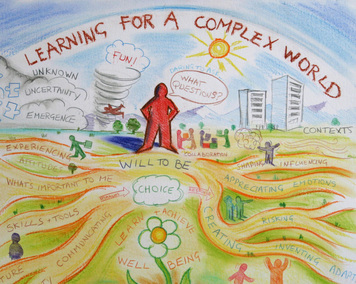
I like the idea of learning for a complex world (5) because it embraces learning and development needs for a lifetime of working with complexity rather than merely studying to pass exams.Traditional academic forms of higher education are founded on stability and certainty and seek to control learning and development within prescribed outcomes-based models of education. They work predominantly with abstract book knowledge and theoretical approaches to problem working. In terms of the Cynefin framework higher education tends to position learning in the simple and complicated domains. Consequently, these forms of education do little to prepare people for the really significant disruptions they will face in their life. Formal education can equip us with knowledge, understanding and ways of thinking that can assist us in particular contexts but it is limited in so far as it cannot offer us the experiences of actually dealing with complex situations as they emerge in the social world that is our life outside the classroom.
The real educational challenge for higher education is to help learners prepare themselves for the disruptions, some forced some chosen, that they will undoubtedly encounter in their lives. In helping learners develop the knowledge, capability, creativity, will and resilience to deal effectively with the full range of life situations we are developing their ability to comprehend and appraise situations of different levels of complexity, and act appropriately and effectively. We do this intuitively throughout our lives because that is what life is about. It stands to reason that a university that adopts a lifewide concept for learning and development (6) extends the opportunity to engage students with the situated and contextualised environments in which such complexity emerges. That is why institutions that seek to encourage learners to draw on their whole life experience for their own development are moving in the direction we need to go if we are to create an education system that will really help people prepare for their uncertain and unknowable futures.
Biographic Note: Norman is the founder and leader of Lifewide Education
Information sources
1http://www.businessdictionary.com/definition/complexitytheory.html#ixzz3IvgHzpZ8
2 Snowden, D. (2000) Cynefin, A Sense of Time and Place: An Ecological Approach to Sense Making and Learning in Formal and Informal Communities. Conference proceedings of KMAC at the University of Aston, July 2000 and Snowden, D. (2000) Cynefin: A Sense of Time and Space, the Social Ecology of Knowledge Management. In C. Despres and D. Chauvel (eds) Knowledge Horizons: The Present and the Promise of Knowledge Management, Bost on: Butterworth Heinemann.
3 Snowden, D. J. and Boone, M. (2007) A Leader’s Framework for Decision Making.Harvard Business Review, November: 69–76.
4 Gajeel, J. and Chandler, K. (2014) Helping People to Fix their Broken-Life. Lifewide Magazine Issue 12 December 2014 available on line at:http://www.lifewidemagazine.co.uk/ to be published Dec 15th 2014
5 Jackson, N. J. (2011) Learning for a Complex World: A Lifewide Cocept of Learning, Education and Personal Development Authorhouse
6 Jackson, N.J. (2014) Lifewide Learning and Education in Universities & Colleges: Concepts and Conceptual Aids in N Jackson and J Willis (eds) Lifewide Learning and Education in Universities and Colleges Chapter 1 available at:http://www.learninglives.co.uk/e-book.html
At the other extreme is the chaotic domain where there is no perceivable relationship between cause and effect. If this situation happens in your life, you feel totally out of control and overwhelmed physically, intellectually and emotionally. We encounter this out of our depth, never experienced before, situation in some life changing experiences. In these situations we sometimes do nothing, either because we do not want to exacerbate the situation or we feel so overwhelmed that we can't imagine anything we do will beneficially affect the situation. Alternatively, we may feel that we have to act, believing that it is better to do something than nothing. In fact it is only by doing something and seeing the results of what we do that we know whether what we did was effective. The feedback we get from our actions enables us to see what we need to do next. It's a trial and error suck and see, who can help me process. It won't get us out of chaos but it may well take us one step in the direction we need to go.
Between these two extremes there are two other types of situation depicted in the Cynefin framework.
Complicated situations are not single events but involve a stream of interconnected situations linked to achieving a goal, like solving a difficult problem or bringing about a change in one's life. An example might be the way someone searches for, finds, applies for and eventually, after a long recruitment process, manages to secure a new job which will bring about a significant change in their material circumstances. Searching for, finding and buying a house might also fall into this category of life challenge. In such situations there are cause-and-effect relationships but sometimes you have to invest effort into working out the relationships by gathering information about the situation and analysing it to see the patterns and look for possible explanations of what is happening. Engaging in these sorts of challenges is the way we become more expert in achieving difficult things, including finding a job and being a parent with teenage children who are trying to find a more independent life.
Complex situations are the most difficult to understand. They are not single events but involve multiple streams of variably connected situations linked to achieving a significant change or, in the context of life disruption, a collection of situations that have coalesced and conspired to make a situation very messy and difficult indeed. In their article Jan Gajeel and Keith Chandler (4) describe life scenarios where a severe illness, leads to depression, leads to loss of job, leads to economic problems and perhaps loss of home, leads to relational problems in the family or the loss of job leads to economic problems, leads to health and social problems like clinical depression and family problems; a divorce leads to loss of family identity, leads to a depression, leads to loss of job. These are complex and very messy situations that may tip people into chaos and without help, few people are able to create a new and better life for themselves. In such situations the cause-and-effect relationships are so intermingled that things only make sense in hindsight and sometimes well after events have taken place. The results of action will be unique to the particular situation and cannot be directly repeated. In these situations relationships are not straightforward and things are unpredictable in detail. People involved may not know the cause of the change that they have been involved in or ascribe the source of change to something that is quite removed from the trigger for change. The way you make progress in understanding what is happening is to sense the patterns of change and respond accordingly. This is exactly where the construction of narratives can help especially if the process is aided by a trusted empathethic facilitator.
Learning for a Complex World
I like the idea of learning for a complex world (5) because it embraces learning and development needs for a lifetime of working with complexity rather than merely studying to pass exams.Traditional academic forms of higher education are founded on stability and certainty and seek to control learning and development within prescribed outcomes-based models of education. They work predominantly with abstract book knowledge and theoretical approaches to problem working. In terms of the Cynefin framework higher education tends to position learning in the simple and complicated domains. Consequently, these forms of education do little to prepare people for the really significant disruptions they will face in their life. Formal education can equip us with knowledge, understanding and ways of thinking that can assist us in particular contexts but it is limited in so far as it cannot offer us the experiences of actually dealing with complex situations as they emerge in the social world that is our life outside the classroom.
The real educational challenge for higher education is to help learners prepare themselves for the disruptions, some forced some chosen, that they will undoubtedly encounter in their lives. In helping learners develop the knowledge, capability, creativity, will and resilience to deal effectively with the full range of life situations we are developing their ability to comprehend and appraise situations of different levels of complexity, and act appropriately and effectively. We do this intuitively throughout our lives because that is what life is about. It stands to reason that a university that adopts a lifewide concept for learning and development (6) extends the opportunity to engage students with the situated and contextualised environments in which such complexity emerges. That is why institutions that seek to encourage learners to draw on their whole life experience for their own development are moving in the direction we need to go if we are to create an education system that will really help people prepare for their uncertain and unknowable futures.
Biographic Note: Norman is the founder and leader of Lifewide Education
Information sources
1http://www.businessdictionary.com/definition/complexitytheory.html#ixzz3IvgHzpZ8
2 Snowden, D. (2000) Cynefin, A Sense of Time and Place: An Ecological Approach to Sense Making and Learning in Formal and Informal Communities. Conference proceedings of KMAC at the University of Aston, July 2000 and Snowden, D. (2000) Cynefin: A Sense of Time and Space, the Social Ecology of Knowledge Management. In C. Despres and D. Chauvel (eds) Knowledge Horizons: The Present and the Promise of Knowledge Management, Bost on: Butterworth Heinemann.
3 Snowden, D. J. and Boone, M. (2007) A Leader’s Framework for Decision Making.Harvard Business Review, November: 69–76.
4 Gajeel, J. and Chandler, K. (2014) Helping People to Fix their Broken-Life. Lifewide Magazine Issue 12 December 2014 available on line at:http://www.lifewidemagazine.co.uk/ to be published Dec 15th 2014
5 Jackson, N. J. (2011) Learning for a Complex World: A Lifewide Cocept of Learning, Education and Personal Development Authorhouse
6 Jackson, N.J. (2014) Lifewide Learning and Education in Universities & Colleges: Concepts and Conceptual Aids in N Jackson and J Willis (eds) Lifewide Learning and Education in Universities and Colleges Chapter 1 available at:http://www.learninglives.co.uk/e-book.html




 RSS Feed