norman's website
  • Home
  • Blogs
    • Scraps of life blog
    • Creative Academic >
      • BYOD4L BLOG
    • Garden Notes
  • Books
  • Change
  • Creativity
  • Professional services
  • Contact me
  • EC-Conference
  • Delft
  • luminate
  • OU employability
  • Qinghai
  • CISC
  • NTU
  • creativejam
  • CRC
  • GMIT
  • BNU STUDY VISIT
  • AIT
  • portsmouth
  • DIT
  • TLC
  • BERA
  • ICOLACE4
  • PDP
  • OUC
  • MMUni
  • Derby
  • dmucreatives
  • Chester
  • Brighton
  • Buckinghamshire
  • Hallam
  • St Marys
  • LIMERICK
  • kingston
  • UWL
  • SEDA
  • MACAO
  • Beijing
  • IFIUT
  • CRA seminar
  • FBSEworkshop
  • birmingham
  • Creativity in Higher Education
  • graduatestandardsprogramme
  • MAKING MEANING

A few reflections on ​#creativeHE Imagineering

25/4/2016

1 Comment

 
​My participation in #creativeHE Imagineering was another significant learning experience for me as it was the first one I had led. In earlier posts I described the design and my thinking behind the design then the process of what emerged through the 7 days of interaction. In this post I want to stand back and try to see the bigger picture.
 
I now see my creativity as an ecological process involving myself, in relationships with and interacting with my physical and virtual environment, with the people, ideas, tools, technologies and other resources in it and with what emerges from it. Everything seems to me to be relational. If I don't form a relationship with something then nothing happens with that thing.
 
It's a continuous search for the affordances through which I can utilize my creativity, my knowledge and beliefs which emerges through the circumstances of my life: #creativeHE being one potential outlet that was important during the period of time it was active.
 
This ecological model seems to fit well my observations of my involvement in #creativeHE. I effectively created an ecology for social learning. It differs from an ecology which is teacher led in the sense that the main resource for learning is distributed through the participants and the relationships we all have with the enterprise and with each other. It's through these relationships that people are motivated to share their ideas and understandings, that generates the knowledge from new insights emerge. Nevertheless, as the leader of this social learning project I had a major influence on overall shape of the process through my design for the process that spanned 7 days and provided basic resources and questions for inquiry around which conversations could form.
 
Social learning is a meaning making process – someone shares something that they find meaningful and the conversation emerge from interaction of people with the resource and with each as they share their own interpretations and what is meaningful to them. The resources I chose (mainly videos and animations) were resources that had meaning to me and the worry is that others will not find them so meaningful. But I reasoned that people who are willing to participate in #creativeHE will always find something meaningful and work from there, and if its not meaningful they will propose something that is – which is what happened.
 
The #creativeHE platform becomes the primary means of conducting the conversation and also the means of curating it in this social learning ecology.
 
Perhaps the biggest area of learning for me is the discovery, yet again, of just how important relationships are in the ecological process that results in learning, development and achievement.
 
It has taken me three iterations of #creativeHE to know what I now know about it. You have to persist to be able to form productive relationships - persistence with people, with ideas with technologies - and in the end the reward is something different and better than we had before eg. understanding, competence and relationships with potential for the future.
 
During the week #creativeHE was running #OER2016 was also running and I followed some of the proceedings via twitter and the OER website. I came across the talk by Suzan Koseoglu & Maha Bali's on The Self as an Open Educational Resource in which they claim We OURSELVES can be open educational resources. Anyone can be an open educational resource.
 
While they were pitching their ideas in the OER forum (rather than an open learning context) the principles they elaborated are relevant to the open learning (self-education) context of #creativeHE. In their view you become an open learning resource when:
  • [You] Make your processes open (e.g. as you think through your teaching or thesis research, defend thesis publicly)
  • [Are] willing to change, have your ideas and your values challenged and shifted
  • [Are] open to reevaluating your worldview when dealing with people very different from yourself
 
And you share something of yourself making yourself vulnerable for example by:
  • Posting incomplete thoughts or raw processes - open self to critique and possibly worse esp in academia
  • Exposing own weaknesses (e.g. illness)
 
But we can only do these things if we trust that the process and the people in it will not take advantage of our vulnerability and we will not be ridiculed or criticised in a cruel way. In return we hope for consideration and empathy, and perhaps points or connection that build on what we have offered. These sorts of feedback show us that the risks we have taken have been worthwhile.
 
#creativeHE with its focus on personal creativity encouraged participants to take risks and reveal important things about themselves: to participate you had to be prepared to share yourself, to become an open learning resource,
 
The circles activity, for example, invited people to engage in an activity and share the results of their own creativity. I think it takes courage to show other people your creations. Facilitators played an important role in demonstrating how this process of open sharing works within a mutually supportive community of shared interest and other participants joined in, but many other members of the community did not.
 
That this openness works for some participants is clear from the posts that were made but these only represent about 10% of the registered community and the question in my mind after this experience is something like:
 
Are many people who sign up to an open social learning community, like #creativeHE, afraid to share publically their perspectives, beliefs and creations because of the vulnerability demands such learning ecologies require?
1 Comment

Emerging Reflections on #creativeHE Imagineering

19/4/2016

0 Comments

 
Picture
​I am constructing this reflective commentary as the #creativeHE Imagineering in HE conversation unfolds in order to record my thoughts and responses as they emerge
 
It's funny how plan's get adapted/enhanced even during implementation. As soon as the #creativeHE process started I began posting the daily activities on several platforms simultaneously - 3 different Google + sites, two group pages on facebook, my linked-in updates and twitter. Only twitter had featured in my planned design but intuitively posting on the other sites seemed the right thing to do. I think as a result of this we attracted a number of people to the #creativeHE site who otherwise would not have come. However, by Day 3 I had changed my plan for twitter, which was essentially promotional, to one of directly targeting individuals to participate and add their views to the conversation. This was supplemented with emails to individuals.

FEAR leading and facilitating an event is full of emotion and one of the biggest emotions is fear - fear that no-one will participate and fear that people will say its rubbish. The biggest fear for anyone designing a learning activity is that people will not engage in the activity because they do not find it engaging - they might not see the affordance in the activity that I could see or they might not be motivated to realise the affordance.  I have come to realise that involvement requires commitment (effort and time), which is often a relational thing, and the adoption of a playful mental state in which critical judgement is suspended. I was very grateful for the people who posted, mainly the people who had agreed to help facilitate the process, who provided leadership for other participants who were watching but not sharing.  I feel the committed few who engage in the conversation, share their perspectives on behalf of the whole community of interest.

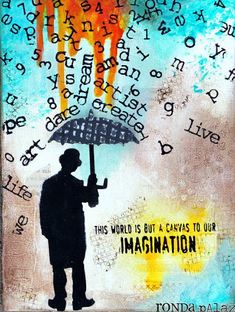
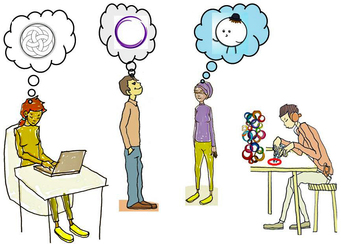
DAY 1 IMAGINE A CIRCLE and lets see where it takes us.The 'imagine a circle' activity was added at a late stage. It was intended as a sort of ice breaker to get things started. On the morning of Day 1 I woke up thinking I needed an illustration for my post. I had an idea for it. I decided to do some research using google images - using a variety of search terms I greatly expanded my visual knowledge of circles. In engaging in this process I was reminded that my starting point for many projects involving my creativity was to try to find out more and through this process motivate and inspire myself with the ideas and creations of others. In making my illustration I used tools that were familiar powerpoint, snipping tool, paint and photoshop. Resources that I had already (cartoon figures) and circles I found on google images. I composed a narrative picture to reflect the purpose of my post and try to give it more meaning.
 
The posts on DAY 1 #creativeHE  illustrate very well a number of features relation to the inquiry - what's it like to be creative? They also illustrated very well the spirit of social learning, namely a constructively playful orientation in which critical judgement is suspended

The facilitation team did a fantastic job in helping to get this conversation underway.

Picture
DAY 2 WHAT DOES BEING CREATIVE MEAN IN YOUR OWN PRACTICE or OTHER PERSONAL CONTEXT?
I must admit I wasn't sure how people would respond to this stimulus which was in the form of a blog post called Imagination Canvas http://blog.sizzix.com/imagination-canvas/ in which an artist tells the story in pictures and words of her creative process. What emerged was an interesting conversation in a single thread (unlike the individual posts of Day1) in which quite diverse and sometimes oppositional perspectives were offered. It made me think that people approached the question from one of three positions - the first which is the one I assumed was that this was a story about someone who was inspired to engage creatively with a problem they cared about, and used media, tools and techniques that they had mastered to produce a picture that they shared together with their process. I liked it because they shared the technical details and reasoning within their process. The seconds position was to see the artists process as mechanistic and to contrast that with the unique approaches to tackling a problem in situations that are uncertain and social rather than in the controlled technical environment of the artist. The third position, coming from someone who also had artistic skill, was to question whether there was anything creative which made me think that perhaps we judge the creative efforts and works of others according to the specific knowledge and understanding we have of the field in which the work was produced. In other words we more readily suspend our critical judgement in domains where we lack knowledge and skill but use this judgment when we ourselves are a knowledgeable practitioner. From an imagineering perspective all these positions are valid but they have different implications if we were to apply them in the higher education teaching and learning context. I could see from the conversation already that there was a reluctance to engage with the imagineering part of the process and began to have a vague idea for a follow-up process that specifically engaged with the ideas that emerged from this process.

​The facilitation team gave great support through their contributions to the conversation.

DAY 3 WHERE DO YOUR GOOD IDEAS COME FROM?  The Steven Johnson talk that has been animated is a great way to encourage you to think about where your own ideas come from. I hoped that by inviting people to share an example we might generate a number of useful perspectives. https://www.youtube.com/watch?v=NugRZGDbPFU

Although members of the facilitation team were very much involved new participants began to contribute and an interesting conversation unfolded  with a number of common themes emerging.

* The idea that ideas pop into our head when we are not thinking about the problem or turning away from the problem doing something completely different to solving the problem
* the idea of ideas colliding or intermingling
* the idea that many of our ideas are 'stolen' or we piggy back on the ideas of others: 'my good ideas are stolen, repurposed and adapted from things that began somewhere else - sometimes in different contexts'.
* the idea that act of playing around with ideas or just playing provides a mental and physical state that is helpful to the formation of new ideas
* the idea that ideas flow when we are deeply committed perhaps in love with the thing we care about

One of the most powerful wellsprings of creative energy, outstanding accomplishment, and self-fulfilment seems to be falling in love with something — your dream, your image of the future. Paul Torrance

In the absence of being able to engage the community other than through a post I adopted a new tactic. I started to become more meddling in my facilitation by inviting specific people I know, who I thought might be tempted to contribute to the discussion - the three people I emailed all confirmed what I already believe, that active participation requires relationships. I already had a relationship with these people and I'm sure that this facilitated their involvement.
I then extended my meddling and invited a leading researcher and thinker in the creativity field (Scott Barry Kaufman) to join the discussion via invitations on twitter. I also invited another active social media user and thought leader Julian Stodd to share his thoughts on the collision of ideas and creativity.

I also tried to draw in people via twitter who I knew were interested in the idea of openness by posing a question that connected their interest to our inquiry and then in for a penny in for a pound - I tweeted a challenge to the Open Educational Resources conference #oer16 which is running concurrently. While my activity expanded my following none of the people I contacted directly responded. Still it was worth a try!!

The facilitation team are giving great support to the event - I have come to see this group of people as having the conversation on behalf of the community of interest that has formed around #creativeHE
Picture
DAY 4 WHAT'S IT LIKE TO THINK LIKE A DESIGNER?
Ever since I was introduced to creative thinking and group facilitation techniques by Fred Buining 15 years ago I have felt that there must be space in higher education for deploying these techniques. Over the years I have facilitated enough workshops and designing process to know that the technique works, although I must say I do not tend to use the technique on my own creative projects. So I was looking forward to hearing what others had to say.
 
The animation offers five key principles underlying Design Thinking.
  • Learn from people
  • Find patterns
  • Design principles
  • Make tangible
  • Iterate relentlessly
 
Other principles were offered through the conversation.
- identify the key challenge or question
- always search for a (more) elegant solution;
- keep it as simple/minimal as possible
 
Or other sets of principles 'I have been influenced greatly by the ten principles espoused by the brilliant designer Dieter Rams at Braun, and have written about applying them in a pedagogic context in Design for Learning
https://www.heacademy.ac.uk/sites/default/files/designforlearning.pdf
 
Some participants liked the idea that design thinking provides a structure for enabling you to make a journey of exploration. 'What I also like from the video was a phrase about knowing the design process will take you somewhere interesting.

Anther theme was that formalised design thinking processes are useful for some problems (eg industrial business design problems) but perhaps are less useful for personal projects like writing, painting and other artistic representations. In contrast, one participant felt it could be used for anything including writing a poem 'I think that it takes us back to the idea of a craft - that is essentially iterative... and frees us from the notion that we have to be inspired.' Perhaps DT methods are also useful where you want to harness the imaginations and thinking capacities of many people.
Before and during #creativeHE I have noticed that there has been a steady trickle of people wanting to join the Google+ group so that over 200 people have now registered on the #creativeHE google+ site (about 30 new people). This tells me that the #creativeHE events themselves with the promotion on social media are an important way of building a community of interest.
 
Once again the core facilitation team led the conversation through their posts and comments. The actual number of participants remains small, although some new people posted today. I like to think that many people are connecting to the community and reading the posts but we have no way of knowing. I have been thinking that we should try to gather the views of people who read the posts but who do not contribute. I'm going to have a go at a short on-line questionnaire to see if we can gather some views.

DAY 5 WEDNESDAY 20th  WHAT CAN WE LEARN ABOUT CREATIVITY FROM CREATIVE PEOPLE?

I believe that we can learn a lot about creativity from people who have done something creative. Mostly we do this from observing people, like colleagues or friends at close quarters, often when we are collaborating with them and they share with us their thinking and decision making processes and subsequent actions. But we can also learn in other ways for example when people write biographies, or researchers like Mihaly Csikszentmihaly interview people as in his book on the Psychology of Flow, or when we interview people ourselves if we are involved in research. I conducted many interviews with students while working at the University of Surrey a few years ago and learnt about the ways they used their creativity. There are also vast resources on the internet as creative people record their thoughts and experiences in blogs, or in talks and interviews.
 
Day 5's stimulus was a YouTube recording of a talk given by photographer Dewitt Jones, in which he tells the entertaining story of an assignment he completed for Dewer's Whisky. It describes a scenario in which he had to produce a photograph of salmon fishing in Scotland for the company's advertising campaign. As the story unfolds he finds himself in a set of circumstances that he did not imagine but his actions and though processes reveal the way in which his technical expertise and imagination intermingle to produce the results he wanted.
A number of participants shared their responses to the video and the key messages to emerge were:
* the need to persevere
* the role that chance  serendipity plays
* the role of instinct/intuition and experience
* the need to look for more than one right answer
* the need for a culture that is not so worried about making mistakes as this is inevitable when you are searching for more than one right answer
* the desire to produce something of beauty with aesthetic appeal
 
My own contribution was formed around the way DJ explains how he created an ecology for learning and achieving within which his creativity was utilised. http://www.normanjackson.co.uk/scraps-of-life-blog
 

A number of suggestions were made from applying what was learnt to higher education
* The need to encourage students' to explore something from different perspectives
* encouraging students to think associatively
* encouraging learners to search for more than one right answer - which of course means involving them in problems that have many possible answers and assessing outcomes accordingly
 
And not surprisingly a key problem with introducing more creative approaches was also identified: 'how can we empower academics and other professionals who teach in HE to make the  first step towards a much more adventurous approach to learning and teaching?

There were fewer contributions to this topic and the conversation was mainly through the contributions of members of the​
facilitation team.


DAY 6 THURSDAY 21st   WHAT CAN WE LEARN FROM A TEACHER ABOUT
ENCOURAGING/FACILITATING CREATIVITY OF OTHER PEOPLE?

Anyone who is interested in trying to understand creativity in their own professional field needs to spend time observing and listening to people in their field, and if they can work alongside them all the better. The apprenticeship model was great at providing the relationships and affordances through which this could be achieved. Sadly, that doesn't happen much in higher education. We have our own experience of being taught and then once we get a teaching post we just go in and do it.. all be it with an organised development process now. So it's great when you go to a conference or workshop and a teacher explains and illustrates what they have done in a way that we can gain insights into their creative process.
 
I wanted to offer HE practitioners in #creativeHE Imagineering an opportunity to listen to a teacher talking about how she tried to promote creativity using the talk given by Tina Seelig. (Stamford University's Design Centre) In it she describes a number of techniques she used to encourage 44,000 participants' to think and behave creatively. So the question was which of these techniques might be used in more traditional settings. 
Ruth Proctor - gave one good answer after she had carefully logged all the things mentioned - ALL OF THEM!  I asked her which of the features she thought she could use in her practice and her response was interesting because it surfaced a really important truth about creativity and about the #creativeHE social learning process.

'Gosh, yes, lots of them! In fact, pretty much the whole list.
I think the first thing I'd take away and share with my students, [& what I try to do in my practice] is the idea of building relationships, & the importance of those positive relationships between teachers and learners to enable learning to happen. I think this is because I see pedagogy, in part, as being a process of interaction between teachers and learners, & that this process, supported by positive relationships, enables learning to take place, [- this view is definitely informed by Siraj-Blatchford's REPEY and influenced by my experience of teaching and learning in the EYFS].

​What is new to me, & what I have only, very gratefully, stumbled across through the Creative HE community, is that you can build these positive relationships virtually too.'

I think +Ruth Proctor identified one of the most important things for successful social learning  Relationships between people, ideas, principles, beliefs, goals, things like tools and resources, and our own and other people's lives are critical for learning and for wanting to learn more. I had just come across a post which uses the football coach to illustrate this very point https://chronotopeblog.com/2016/04/16/is-effective-teaching-more-about-good-relationships-than-anything-else/

​Start with a question?
Stretch imagination
Share a bit about self with others - building relationships
Short 5 min lecture at start of each class
Supporting readings
Discussions
Creative challenges - individual & team challenges - mixing it up
Share and then evaluate, feedback
People who want to keep learning
Levels / layers of engagement / motivation
Surfing the surprises vs iceberg-magnets
Learning from mistakes / others' interpretations - sometimes the story you think you have told is different to the one the listener hears, which is different to the next listener etc.
Difficult to unravel
Find out who's actively involved
Does initial engagement indicate future / enduring engagement?
Does hooking participants in right at the start help to encourage continued engagement / participation?
How to engage those who sign up / show up but do not choose to engage?
Deputise - co-construction of learning? Sharing wealth of learner knowledge and expertise? Collective construction of learning? Supportive learning community?
Promote and float, - teacher as facilitator?
Pick a problem, frame it, share ideas for possible solutions, pick a shared favourite, prototype, test, create a story to communicate the process
Remember to laugh, enjoy, have fun and celebrate successes
Room / space / potential for exploration and experimentation
Innovate
Learning through teaching
Reflecting on learning through teaching, shaping thinking
Virtual / alternative influencing / informing / shaping the real?
Experience meaningful learning
Inspiration from others
Shifting thinking - through participation and reflecting on experience of participation
Powerful learning experiences
Invite experimentation
Coding collaboration
Participating in an adventure
0 Comments

​Designing #creativeHE Imagineering in HE

15/4/2016

0 Comments

 
Picture
I wanted to share my design process. It's the first time I have developed a design for an on-line social learning event.
 
My process began around 15th March (one month before the event) when I gave some thought to how the process might be structured.  I had the idea of 'imagineering' for some time, I liked the word and the emphasis on imagining. I followed the basic model that Chrissi had established for #creativeHE of a short post at the start of each day which was intended to stimulate imagination and personal inquiry.
 
I looked around for some resources that might provide the catalyst for thinking and then constructed an overarching question around each resource. I tried to imagine how someone might respond to make sure that the resource and the questions opened possibilities - which they did. I prepared some notes which were intended to make my design explicit for myself and then discussed the overall shape with my WCIW project team (Jenny, Roger, Nikos and Rafaela) in a google hangout on March 20th.  The team thought the overall structure and guidance notes were fine.
 
Simultaneously I invited Chrissi Neratntzi and Paul Kleiman to critique my design. They provided some helpful advice which I incorporated and then did some more thinking on the design. I decided to start the event on the Sunday reasoning that most people might have a little more time to spend on familiarising themselves with the platform and the process. Then I added a warm up activity for the Saturday reasoning that people are more likely to get involved on the Sunday if the site is already active.  I picked up the idea for the warm up exercise from a facebook post made in the Our Creative Life group.. I also refined the questions and the notes for facilitators. In the few days before the event I did a lot of gardening and I was conscious that quite a few ideas came to me while pottering - good ideas definitely emerged from turning ideas over while gardening.
 
I thought about the facilitation team and invited several more people, some who had facilitated #creativeHE before and others who might bring additional dimensions to the process including Patrick a cartoonist who I hoped would help visualise ideas and Graham a musician who I hoped might create a song. My design included notes for facilitators to share my own thoughts on the resources we were using and to help them prepare. I also wanted to explain that their role was not just to assist (guide on the side) but it was also to lead and provoke (meddler in the middle).
 
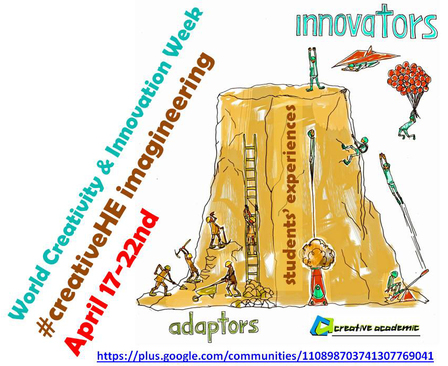
I also prepared some posters and accompanying notes to advertise the social learning event. I always find it helpful to reduce something to an essential message - 'this is what its about' and then this feeds back into the design.
 
There is no doubt that designing was a progressive process. In fact its progressive from the moment you start thinking about it until the moment that particular part of the design is implemented. The main effort was in the few hours I first sat down 4 weeks before #creativeHE was due to happen to create the overall framework. This was the point at which most creative effort was expended in deciding a process, the content to support the process and the inquiries that would be facilitated through interacting with the content.  But there followed 3 or 4 weeks of gaining feedback tweaking the design and refining the details, with the odd additional idea being added. I'm sure that once it is implemented I will get feedback to tell me how well it achieves what I had hoped and get ideas for doing it better next time.

Picture
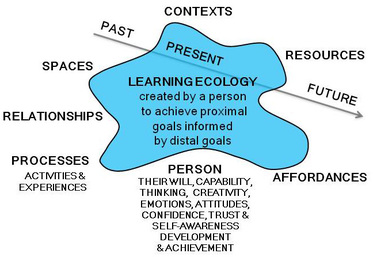
From an ecological perspective. I had my context - a social learning asynchronous on-line event the success of which formed my proximal goal which was informed by my distal goals of developing Creative Academic.
 
My design embraced the virtual space of the #creativeHE platform and the physical spaces which participants inhabited. I sort to create spaces for thinking for personal exploration and inquiry, a space for social interaction through which sharing ideas, resources, experiences and practices could be shared and relationships formed. I drew on my past experiences of #creativeHE and knowledge derived from these experiences knowing that new knowledge would emerge in the present which would extend over about 7days. Within this timeline I create a process around daily inquiry themes. I selected resources that I hoped would stimulate the imaginations and involvement of participants.  Relationships are critical in my design I drew on past relationships from previous #creativeHE events and was grateful for the willing involvement of the facilitators. I was also grateful for the involvement of our world creativity and innovation week project team as facilitators and quite late on I tried to add some additional creative capacity in the form of an artist/illustrator to help visualise the ideas.
 
The affordances for learning and creativity are in the way participants (including me) perceived this ecology and interacted with it.  Perceptions, motivations - willingness to be involved and to share and interact, and reflection on what emerges are all important to an enjoyable and successful outcome.
 ​
Ultimately, whatever emerges from this process will feed into my thinking and actions in the future.

THE TANGIBLE OUTCOMES FROM THIS DESIGN CAN BE VIEWED AT
https://plus.google.com/communities/110898703741307769041


0 Comments

#creativeHE Imagineering in Higher Education

7/4/2016

4 Comments

 
Picture
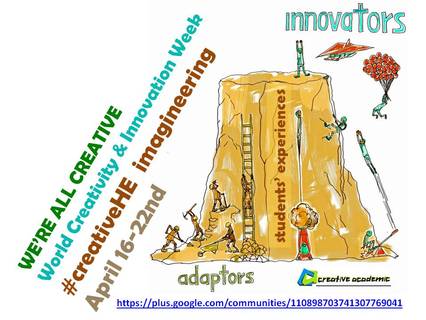
Its always nice to feel part of something bigger than yourself and this year we (Creative Academic) are participating in  the annual World Creativity and Innovation Week (April 15-21).

One of its aims is to encourage people to use their imaginations to solve problems that are relevant to their work and other everyday contexts in their lives. To celebrate WCIW and show that higher education is involved in the problem of creating a more creative society, I have agreed with Chrissi Nerantzi (founder of the #creativeHE platform) to facilitate a social learning event. I've participated in two #creativeHE events but this is the first I have tried to lead. I picked the theme of imagineering to emphasise that this is all about using imagination.


Imagineering involves using imagination to create ideas and invent possible ways in which these ideas might be implemented. The context for this imagineering event is the enhancement of teachers and students' and teachers' creativity and creative development.
 
This social learning and sharing experience is open to anyone who would like to use and share their imaginations. While the main focus is on higher education participants don't have to work in higher education to participate. The event is part of Creative Academic's contribution to World Creativity & Innovation Week which we are undertaking in collaboration with Chrissi Nerantzi (founder of the #creativeHE platform) and the Centre for Excellence in Learning and Teaching at Manchester Metropolitan University.
 
Process: Each day is underlain by a question to encourage personal inquiry and a short post to stimulate imagination which will be made at 7am (UK time)  on the #creativeHE platform, together with an invitation to share ideas, feelings, experiences and practices in response to this stimulus.

Inquiries
What's it like to be creative?
What does being creative mean in your own practice or other life contexts?
Where do your good ideas come from?
What's it like to think like a designer?
What can we learn about creativity from the experience of a creative professional?
What can we learn from a teacher about encouraging & facilitating the creativity of other people?

Culture: Social learning is not hierarchical - we all have the potential to be teachers and thought leaders, and we are all learners and we are all makers of meaning and tangible expressions of our imaginations. Freedoms: #creativeHE gives people the opportunity to join a conversation and share their thoughts, feelings, experiences and practices with other people. It also gives people the freedom to experience the process by themselves if they do not want to share their thoughts.

Facilitation: The role of facilitator is firstly to acknowledge, appreciate and value the contributions participants make, and help them reflect on their posts. Secondly to lead and add value to the conversation by sharing your own thoughts, perspectives, experiences, resource links, digital artefacts and questions.  This means the facilitator is not only a guide on the side but also a meddler in the middle.
 
My hope is that both participants and ourselves will find the conversations enjoyable, useful and inspiring.  At the end of the process the discussion (or selected aspects) will be curated as a downloadable pdf. Depending on what emerges we have the potential to publish 'highlights and insights' in Creative Academic Magazine (CAM4B) in May.

As in previous #creativeHE events I will keep a record in my blog of the most important things I learn. 

PLEASE JOIN IN

4 Comments
     Creative Academic 
    #creativeHE

    this blog relates to my work for Creative Academic & contains insights gained from participating in ​the #creativeHE conversational space
    CREATIVE ACADEMIC WEBSITE
     #creativeHE
     FACEBOOK FORUM

    Author

    I am thankful for all the opportunities I  have to use my creativity and experience the creativity of others

    Archives

    November 2020
    April 2020
    March 2020
    January 2020
    December 2019
    May 2019
    April 2019
    February 2019
    April 2018
    March 2018
    January 2018
    December 2017
    May 2017
    April 2017
    March 2017
    January 2017
    November 2016
    October 2016
    July 2016
    April 2016
    March 2016
    February 2016
    November 2015
    October 2015
    September 2015

    Categories

    All
    Affordance
    Visual Thinking

    RSS Feed